Reframing universal health coverage: From coverage to capability
Rethinking health systems for impact

For more than a decade, universal health coverage (UHC) has been the north star of global health reform. A promise that everyone, everywhere should have access to quality health services without suffering financial hardship. It is a powerful idea – moral, political, and economic.
Yet, somewhere between aspiration and implementation, UHC has been reduced to a number: coverage. How many people are insured? How many benefit packages are available? How many facilities are accredited? We have equated the expansion of coverage with the achievement of care. But coverage, while necessary, is not sufficient. It tells us who is in the system, but not whether the system is actually capable of providing care.
Across many countries, including the Philippines, reforms have largely centered on increasing insurance enrollment. Rightly so, we passed the Universal Health Care Act in 2019, a national policy that reinforced this momentum, placing emphasis on expanding financing and coverage. Since then, the country has made strides expanding public health insurance coverage through automatic membership and benefit eligibility – more Filipinos are now “covered”. On paper, this reflects progress, but in practice, it often masks persistent inequities in access, quality, and outcomes, variations that depend on geography, income, local political commitment, and health system maturity.
Consider Maria, a diabetic mother in a small rural village. She is insured, technically protected. Yet the nearest facility with insulin and specialist care is two towns away. The rural health center is overcrowded, chronically understaffed, and often out of stock of essential medicines. She has PhilHealth coverage, yet lacks real access — no continuity, no reliable primary care, and no capability for life-long management of a chronic condition.
Coverage gave her entitlement, but it did not give her care. This is the central tension of UHC-as-coverage: we can expand insurance faster than we strengthen systems. We can expand the financial safety net while the service delivery platform remains weak, underfunded, or fragmented.
From Coverage to Capability
If we want UHC to deliver real health impact, we need to reframe it — from counting insurance coverage to assessing system capability. This requires asking a different set of questions:
From “how many are covered?” to “can the system deliver essential services to everyone, reliably and equitably?”
From “what benefits are guaranteed?” to “can health facilities actually provide them?”
From “how do we protect people from financial risk?” to “how can we build health systems that prevent the risks in the first place?”
This reframing moves the discussion from entitlement to empowerment — from expanding access on paper to building systems that are capable of delivering on that promise.
A health system that espouses UHC must therefore build three core capabilities:
Institutional capability. UHC requires institutions that can govern, coordinate, and learn. Fragmentation between national and local governance remains a core concern, particularly in decentralized settings, which often leads to inefficiencies and blurred accountability. Local autonomy can inspire innovation, but also variability, as observed in the Philippines. Building institutional capability means strengthening stewardship: aligning financing, service delivery, and accountability under a coherent vision.
Service delivery capability. Coverage is hollow without a functional network of care. We need capable primary care providers who can diagnose and manage chronic conditions; referral systems that actually move patients seamlessly through levels of care; and supply chains that do not falter under demand. The goal is not merely to build more facilities but more connected care.
Health workforce capability. UHC relies on people – competent, motivated, and supported health workers. A well-trained nurse with adequate supplies and supervision can have more impact than a new hospital building without staff. Capability means investing in workforce education, retention, supervision,
and safety.
The Capability Approach to UHC
This framing recently crystallized for me during a postgraduate course I co-facilitated on Health Systems and Policies for UHC at the Institute of Tropical Medicine in Antwerp, Belgium. In one session, we unpacked the Levesque framework for health care access, which illustrates that access is not a single doorway but a pathway shaped by five system attributes (approachability, acceptability, availability, affordability, and appropriateness) and five user abilities (ability to perceive, seek, reach, pay, and engage). A realization struck me:
Even with full coverage, a person may still fail at any point along the access pathway when the provider and the person lack the capability to deliver or utilize care.
Maria has insurance but lacks geographic access to services (ability to reach), is constrained by service schedules and stockouts (availability), and receives fragmented care (appropriateness). Levesque reminded us that coverage is only one milestone in a much longer and complex journey to real access.
This is precisely what economist and philosopher Amartya Sen argued that true development is not about resources or entitlements, but about capabilities – the real freedom people have to lead healthy, productive lives. Applied to health, UHC should do more than guarantee financial access to services, but enable capabilities for health:
The capability to seek care without fear of cost or stigma.
The capability to receive continuous, quality care across one’s life course.
The capability of communities and health systems to adapt and respond to emerging needs.
A system that builds these capabilities becomes equitable, resilient, and people-centered, which is the true spirit of universal health care.
The Promise of Capability-Oriented Reform
Reframing UHC around capability also changes how we measure progress.
Traditional indicators such as insurance coverage, utilization rates, catastrophic spending remain important but incomplete. We must now complement them with measures of system capability, such as:
Availability and continuity of essential services.
Strength and maturity of primary care networks.
Responsiveness of local health governance.
Health workforce retention, morale, and competency.
Community trust, literacy, and satisfaction.
These indicators tell us not only how many are covered, but how well people are actually cared for.
Building the capability of the health system takes time. It demands long-term political commitment, prioritizes investment in primary health care, and shares governance across fragmented structures. But it is also what transforms UHC from a financing mechanism into a social contract.
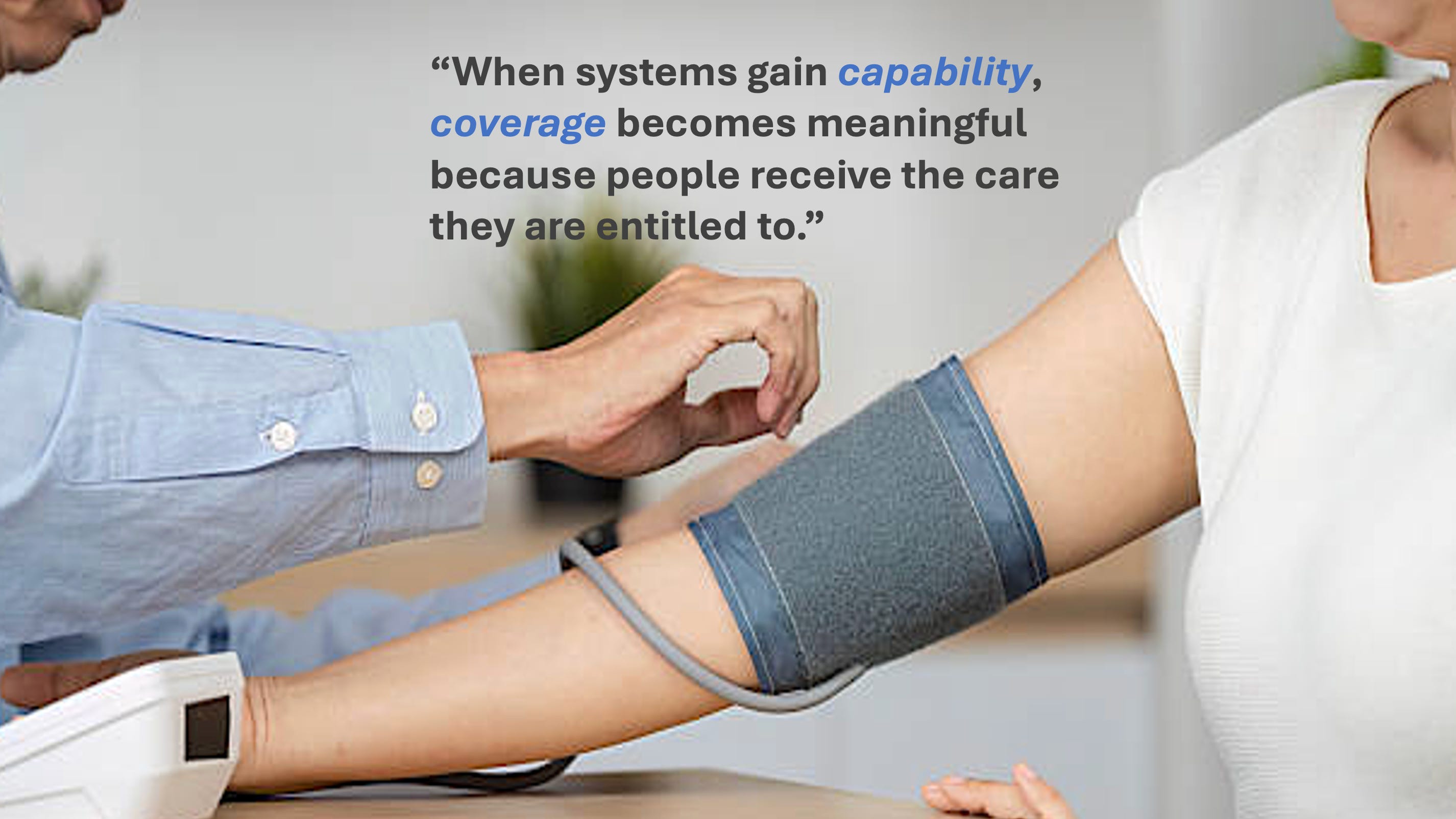
When systems gain capability, coverage becomes meaningful because people receive the care they are entitled to. Reframing UHC in this way doesn’t discard the goal of coverage; it actually deepens it. It makes the promise of UHC not just universal in name, but universal in experience.
In summary, UHC is not a destination. It is the daily work of capability-building. It is aligning national vision with local action. It is transforming coverage entitlement into actual care. And it is cultivating systems that can learn, respond, and adapt.
The future of UHC in the Philippines will not be measured by how many are covered, but by what the health system can do for those it covers. Universality is achieved not when everyone holds a health insurance card, but when every Filipino holds a capable system that keeps them healthy. RX